How much trust do you place in the architect of your home golf course? Perhaps even more important, how much trust is placed in the architect at an away course? Not surprisingly, this question probably doesn't enter most golfers minds as they play their round, yet it can be a very important factor in the success of a round. Granted, there is trusting the yardages that are marked on the course, but often times blame for inaccuracy is on the maintenance staff that can't use a laser range finder correctly.
The idea is our assumption that the architect is telling the truth as to the nature of the hazards on the course. We rationalize that bunkers are at the corner of the dogleg to give the golfer something to think about if they chose to cut the corner. We understand that contour in the green is designed to make for interesting hole locations and angles of attack into the green from the fairway and that leaving the ball below the hole will leave an easier putt. But, how do we know for sure?
Ever cut a corner of a dogleg and find yourself with a bad angle into a green or a nastier second shot?
Ever stand over a putt thinking you've read to little or too much break and slowly inch your aim left or right?
Believe it or not, but architects like to play with your mind. Temptation, of course, is the most commonly known way they do this. We are tempted to carry as much of a diagonal hazard as we dare, and we are tempted to fire directly at a hole that looks benign from the fairway. Temptation, however, is not the only way architects play with you.
Next time you play a hillier course of some repute, take a look at how the slopes around the greens and fairways compound your eyesight. Good architects will make their unnatural grading and mounding integrate with surrounding and more natural contour and sights. Built up tee boxes, or those benched into a hillside, will have their built up slope match the grade of the hill side they were built into and both lines will run parallel. This actually does to things: make the golfer comfortable and make the golfer not notice. Well-integrated slopes are hidden from our eyesight precisely because they don't stand out. We may not notice that we are reading a putt from a sidehill lie. We may think the green is flatter than it is. Our aim may shift down the natural line of our eyesight and right toward a hazard lurking in front of a well-integrated mound.
Take heed and notice next time you're out slapping it around the course. You may find yourself placing too much trust in the guy who was hired to make your score higher.
31 March 2006


25 March 2006
A Treatise on Equipment
I received a comment regarding my blog and the lack of equipment opinions and their influence on architecture. I've decided to state my feelings regarding technology.
I believe that they ball needs to be rolled back. I would like to see a return to either the Titleiest Professional-era of technology, or the first version of the Titleist Pro V1. This feeling is probably no coincidence in that it corresponds to the time when I turned professional.
It may well take a nuerotic to pay $100 and use $1500 of equipment in order to spend 5+ hours on a golf course that takes up real estate to the tune of 200+ acres. Economics drive any pasttime, and golf is no different. Golf has a problem - a serious problem. These aren't appealing numbers. Granted, these numbers are probably indicative of a limited percentage of those that actually play the game, but indeed, this higher end is the ultimate cost driver. As such, a simple solution must be found if the game is to continue retaining players (forget growth, let's worry about people STAYING in the game - since when is turnover a good thing?).
However, I also feel that architecture (the field) cannot make a living by demanding that the ball be rolled back. Simply stretching golf courses to 7500+ yards and whining about how high and far the ball is going is not going to help this game. Architects must be more creative, because frankly, the game is getting too big. I feel there are architectural solutions that are both cost effective and land effecient (the two main drivers that the architect controls) and that are fun and challenging to play (the purpose of hiring an architect in the beginning). I've proposed some of these solutions on this blog, and will continue to do so.
20 March 2006
The Jeff
I had the distinct pleasure of playing Jeffersonville GC yesterday with fellow GolfClubAtlas mate Mike Cirba. This course is the crown jewel of the West Norriton Township, PA taxpayer (that's a muni for those taking notes ;-)) and is also a crown jewel (of many) for Philadelphia golf.
The course is your prototypical Donald Ross/JB McGovern 1931 design that, to me at least, gets better with each subsequent play. My first experience with the course was in a High School match back in 1999, right before a Ron Prichard restoration was undertaken. I returned 3 years later after I turned pro and the difference was night and day. The course as I first encountered it was a pitiable maintenance nightmare. I am not sure if this was before or just after they discovered the Ross pedigree, but I would have never even imagined the sophistication of the design then.
The main affects of the restoration were much better (and integrated) bunkering and larger, more integrated green sites. These greens are a superb test of iron play, and as we experienced yesterday can be quite the challenge when fast. The routing also offers the golfer different angles through which the wind will affect play, and with one exception, no two consecutive holes play in the same direction.
While the first nine has many highlights (the short par 4 2nd, par 5 6th and long downhill par 3 8th among them), the second nine is as fine a test of golf mettle as I've encountered in my, albiet limited, experience. The 11th and 12th holes (formerly 17 and 18) are an interesting pair. The first is a long, uphill par 4. The green dictates play of the rest of the hole and its situation is as near to a "redan" style as I've ever seen on a Ross course. The front right shoulder helps feed a low, running approach.
As was our luck, the hole played dead into the wind - placing a premium on this feature. I was able to successfully punch a 3-iron from about 185 out up the hill and feeding toward the hole location on the left side just over the greenside bunker. I should note that Mike hit a wonderful approach right at the hole that nestled abotu 10 feet away, so while this hole has some features of a redan, it's not a true one as the green does not slope away from the golfer.
17 and 18 are a great finish, and the evolution of the 17th hole is of particular interest to me. 17 is a true dogleg where angles are gained by playing out away from the green near the bunkers at the corner. Playing down 18 is an option, but no true advantage is gained as the hole is both sufficiently long with a green angled in a certain way that the small distance advantage gained is not worth the shot due to the poor angle. Interestingly, this hole may have played much straighter or even as a dead-straight on shot. I'll follow up when I do the necessary research.
Jeffersonville is a sure treat, and the price can't be beat (I'm a poet, and the realization has yet to strike me). It's a worthy trip to anyone taking a Philadelphia golf tour as an accessible, playable, and fun sampling of later Ross.
18 March 2006
The Directional Hazard: Messing with Comfort
One of my latest ponderances regarding golf architecture has been that of what I am beginning to call the "directional" hazard. I am beginning to notice more and more that architects may force a player to aim toward a less favorable area in more ways than one.
The first example of this is noticed at Morgan Hill, a Kelly Blake Moran course in Easton, PA. Kelly's bunkering and green complexes may be considered avante garde by a lot of the Philadelphia school pastiche, and some even have a Raynor/Banks-ish quality to them. They resemble a cat scratch across the landscape, and the depth and direction of the "scratch" confound the next shot by forcing the player to aim in a certain direction simply to advance the ball more than a deep explosion shot would do.
To me, this is a very effective hazard, especially in a day and age where the bunker shot has been rendered "ho-hum" by the better player.
I've also noticed some visual deception in regard to direction. The Par 5, 13th Hole, on PSU White (Park, Jr.) has a large bunker guarding the right side of a blind tee shot. Since the bunker is roughly 200 yards out, the better player has little concern for actually ending up in bunker, however, carrying it renders an extremely difficult decision the next shot. Upon getting to the bunker (and looking down the hole for the first time) the player is confounded by attempting to hug the treeline (and OB) right or playing out to the left for a less-than-ideal angle to the green and a fairway area that falls into two cavernous bunkers. It is a very uncomfortable shot regardless of the aim or choice and the premium on concentration and execution is high.
Interestingly, these sort of features tend to force play to the edges, adding a certain amount of "internal yardage." Indeed, a player forced to zig-zag down a 490 yard par 5 is actually playing the hole at a 530 yard par 5.
I like the idea of simple golf features messing with the golfer's comfort level in an effort to "defend par."
24 February 2006
A Corollary to Ian
The Caddy Shack: Why a blog about being a golf course architect?
The above is the latest blog entry by fellow GCAer and Canadian Golf Architect Ian Andrew. I was struck by his thoughts on his role in architecture, namely:
"I believe a golf course architect's job is not to define a series of difficult tasks, but to make the game as interesting and fun as he can."
I like that, and I feel it draws a neat parallel to my own definition of the golf architect's purpose. The golf architect is charged with posing a series of questions which the golfer can answer. The course's challenge comes not in asking impossible questions, but asking questions which engaged the golfer's abilities to their maximum level. To me, this leaves golfers of all abilities with something to "contribute" to the answer.
A cape hole, for example, may pose the question, "How much of me can you challenge?" Every golfer has a different answer to the question, and each answer yeilds a different question on the next shot.
14 February 2006
Why are tees always built up?
Why do tees get put up on pedestals of ground?
Not only does this look unnatural to me, it also plays unnaturally. Sure, I can understand a little bit of elevation to keep the tee above surface water flow, but is 4 feet of elevation change really necessary for that? Also, since it IS a teeing ground, and the golfer is given the option of improving his lie with a tee or by picking the best spot of ground, I would imagine the tee can afford to be in less-than-optimum condition.
Tee boxes seem to be in one of two locations: flat ground, or benched from a hillside. For the latter example, we often see the box built up on one end so it can match grade with some aspect of the slope.
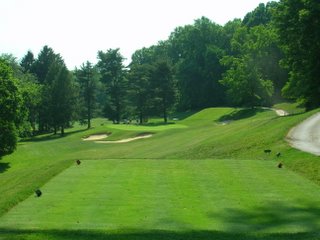
For example: The tee box on the Par 3 4th at Manufacturers' Golf and Country Club, Oreland, PA shown to the left. This is the response to a tee box being built on severely sloping ground, and the green and hole in general dictated the placement of the tee box here. While it may not be the most natural look thing (let's not fool ourselves, random flat shelves of land don't protrude naturally from rolling Pennsylvania hillsides) it is an example of the architecture following the function of the hole. Also note (click on the image for a larger view) how the slope built up to the left MATCHES the grade in front of the tee.
In the more egregious category comes the new tee box on the 13th hole of PSU's White Course. The tee shot on the hole from the old tee (now the back tee) is blind. The 13th being a long downhill par 5 with the crest of the hill positioned in just the right distance from the back tee to make the landing area blind. A new forward tee was built that puts the golfer on a 5 foot high stage, laying the hole out in front of the player - no more blindness, at least I'm assuming that to be the purpose for the height of the new tee box. Functionally, I find this less-than-ideal - as the blind tee shot was used to set up strategic decisions later on in the hole. Aesthetically, the rectangularly symmetric pimple of a tee box looks awful. While I recognize the need and desire for a larger teeing ground, I don't quite understand why several cubic yards of dirt were wasted on this enterprise just for the sake of sight lines down the hole.
While this may be a greater indictment of the growing golf culture for "everything right out in front of you" golf courses, and as such, the natural "form follows function" progression from there - I would think that simple aesthetic taste would ultimately win the day. Both my examples certainly aren't natural in appearance, but there is a limit between elegant and over-the-top.
As a corollary to all this, I just started a thread on www.golfclubatlas.com about the conditioning of tee boxes and their ultimate importance on the game. Is the sacrifice of tee conditioning worth the more playable and elegant grade level tee?
Not only does this look unnatural to me, it also plays unnaturally. Sure, I can understand a little bit of elevation to keep the tee above surface water flow, but is 4 feet of elevation change really necessary for that? Also, since it IS a teeing ground, and the golfer is given the option of improving his lie with a tee or by picking the best spot of ground, I would imagine the tee can afford to be in less-than-optimum condition.
Tee boxes seem to be in one of two locations: flat ground, or benched from a hillside. For the latter example, we often see the box built up on one end so it can match grade with some aspect of the slope.

For example: The tee box on the Par 3 4th at Manufacturers' Golf and Country Club, Oreland, PA shown to the left. This is the response to a tee box being built on severely sloping ground, and the green and hole in general dictated the placement of the tee box here. While it may not be the most natural look thing (let's not fool ourselves, random flat shelves of land don't protrude naturally from rolling Pennsylvania hillsides) it is an example of the architecture following the function of the hole. Also note (click on the image for a larger view) how the slope built up to the left MATCHES the grade in front of the tee.
In the more egregious category comes the new tee box on the 13th hole of PSU's White Course. The tee shot on the hole from the old tee (now the back tee) is blind. The 13th being a long downhill par 5 with the crest of the hill positioned in just the right distance from the back tee to make the landing area blind. A new forward tee was built that puts the golfer on a 5 foot high stage, laying the hole out in front of the player - no more blindness, at least I'm assuming that to be the purpose for the height of the new tee box. Functionally, I find this less-than-ideal - as the blind tee shot was used to set up strategic decisions later on in the hole. Aesthetically, the rectangularly symmetric pimple of a tee box looks awful. While I recognize the need and desire for a larger teeing ground, I don't quite understand why several cubic yards of dirt were wasted on this enterprise just for the sake of sight lines down the hole.
While this may be a greater indictment of the growing golf culture for "everything right out in front of you" golf courses, and as such, the natural "form follows function" progression from there - I would think that simple aesthetic taste would ultimately win the day. Both my examples certainly aren't natural in appearance, but there is a limit between elegant and over-the-top.
As a corollary to all this, I just started a thread on www.golfclubatlas.com about the conditioning of tee boxes and their ultimate importance on the game. Is the sacrifice of tee conditioning worth the more playable and elegant grade level tee?
18 January 2006
Throw 'em a Bone
"Bulls make money, bears make money, pigs get slaughtered."
-As related by Jim Cramer
I've always been a fan of throwing the conservative, pedantic and plodding golfer a bone here and there and let them earn an uninspired par. It especially works on a shortish-mid length par 5 (in the neighborhood of 500 yards). I like the idea that just executing three simple shots and nailing two putts will give someone a par, but making the hole just wide enough and just short enough to lead to temptation.
The hole design below would be best suited for rolling terrain (even dunescape) since there are some rolling features around the green (including dunes over the back and a bunker cut in one of them to cover the approach from the right).
The green has a deep swale running through the middle along the minor axis and is more accepting of a shot from the left side. I am also a fan of bunkers gaurding a chipping area that lies along the ideal approach to the green. Any golfer going for the green in two is subject to the terrain around the green, whereas a more conservative golfer is given room to pluck easier shots from the landscape - earning a fairly benign par.
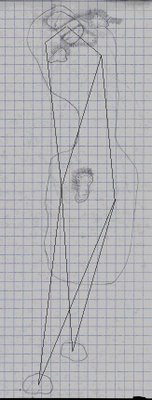
I give you all the Jim Cramer Hole:
-As related by Jim Cramer
I've always been a fan of throwing the conservative, pedantic and plodding golfer a bone here and there and let them earn an uninspired par. It especially works on a shortish-mid length par 5 (in the neighborhood of 500 yards). I like the idea that just executing three simple shots and nailing two putts will give someone a par, but making the hole just wide enough and just short enough to lead to temptation.
The hole design below would be best suited for rolling terrain (even dunescape) since there are some rolling features around the green (including dunes over the back and a bunker cut in one of them to cover the approach from the right).
The green has a deep swale running through the middle along the minor axis and is more accepting of a shot from the left side. I am also a fan of bunkers gaurding a chipping area that lies along the ideal approach to the green. Any golfer going for the green in two is subject to the terrain around the green, whereas a more conservative golfer is given room to pluck easier shots from the landscape - earning a fairly benign par.
I give you all the Jim Cramer Hole:

30 December 2005
The Greatest Joy in Golf
This is from a blog I kept a few years ago. Detailing an experience I had in 2003 regarding my finding a "hidden" but neglected gem in Central PA.
To me, experiences like this are the greatest joy in golf.
I was just in the most hell forsaken place on the planet I think.
After work today, I decided I wanted to play golf. Since the PSUGC is closed for a three day tournament I had to go to a different course.
For some reason, I wasn't feeling Toftrees so I did some searching. I decided on a course about 30 miles southwest of here called Standing Stone. I knew the architect of the club and I like his work so I figured I would give it a try.
The drive down was beautiful, over and through mountains and valleys and what not. The course is off the beaten path some, and unless you are paying attention you would probably miss it. The entrance was narrow and was only one lane. The road gave a good view of the course and I was moderately optimistic at my choice.
The gentleman in the pro shop let me out after I showed him my PGA card. One notable thing about him was his business card, which he gave me. He apparently teaches and does trick shot shows. The golf shop itself was a small hut that was no bigger than a back yard shed and was completely seperate from a larger building used as the club house and restaurant.
The course looks like it was once a really good course. Walking down the first fairway I noticed signs of painstaking and futile effort to put the course back together. It saddened me that I saw half completeled projects with the shovels and other tools still lying around. The fairways were long, and very wet considering the rain we've been getting.
The thing is, the design is there. The holes are routed logically, the greens located on good spots and the bunkering, while overgrown somewhat, follows a path that could be challenging.
I only survived four holes before I couldn't take any more. I made a mental note of the ground, and the basic routing from the score card and left. It is very hard for me to see a remnant of what once was. This was obviously a course conceived by a genius at design (Geoffrey Cornish, for those keeping notes) and it wasn't meant to be this neglected.
To most people, it may be just another course. To me... it's a waste of very good effort.
26 November 2005
The Logical Flaw of Modern Architecture
"I also believe to some degree we made this golf course a little bit more accommodating even for the member because we took out the trees, so it's easier -- they have a little more latitude than they did prior to our work."
-Rees Jones, during the press conference for the changes for the 2006 PGA Championship to Medinah Country Club's No. 3 Course
Mr. Jones,
I read with interest your comments regarding changes you made to Medinah's No. 3 course in light of the 2006 PGA Championship. The above statement immediately piqued my interest and I believe it can be categorized as the logical flaw of modern architecture.
Your statement implies that wider is easier. While this may certainly hold true for golf courses you design and build I feel this may be used as an indictment to your architectural ability (from a design standpoint, at least). The underlying premise of the statement is that the more lateral room a golfer has to play with, the easier a course will be - since the less skilled golfer will need more width to "stay out of trouble."
However, that premise ignores a basic tenet of architecture that his been practiced since formal architecture came into being. Width provides golfers with options. When a golfer is presented with options, he immediately has to make a choice as to how to play the shot. The golf course should be designed and laid out in such a way that some of the options provide the golfer with an easier next shot, and other options allow the golfer to make his own difficulty. This set of choices is the chief challenge presented by the golf architect to the golfer.
It is paramount to keep this in mind when designing a golf course, especially around the green. For example, Donald Ross rarely bunkered the outside of a dogleg, since he felt that an golfer hitting a shot there made his own trouble by making the hole longer. Similarly, Ross's Greens are known for the heavy use of contour and their premium on well-placed longer shots.
Ross, therefore, allowed the golfer to proceed around the golf course as he saw fit; allowing him to pick a path from tee to green that suited his game. However, he also rewarded the golfer by giving him ways to still score, despite choosing a less-than-optimum route.
I feel that your statement above sets two poor precedents. That tree removal will make a course easier, and that wider golf corridors will make a golf course easier. Often times, when clubs chose to plant trees on their courses, they would line the optimum corridor with trees, negating the lesser of the options off the tee and making the golfer execute, instead of think. They took out compromises that golfer could make that were allowed by Ross and replaced them with demands.
I think your efforts to restore and renovate classic courses are noble, however, I feel that your premises and logic are not in line with the original intent of the golf course, as you are known to say.
Humbly and Respectfully,
Kyle Harris
20 November 2005
Cake or Death!?
Kudos if you get the reference in the title.
However, for the purposes of this post, it alludes to the choices golfers make throughout a round.
The best golf courses I've played allow the golfer to pick and choose his way around a golf course, avoiding certain hazards, and in doing so, bringing other hazards into play. I often make a dichotomy in golfers as such: Cunning and Athletic.
The cunning golfer is able to think his around a golf course with less-than-average to average execution. Basically, he knows where and how to miss. This golfer scores by overcoming strategic difficulties with thought and often uses creativity to keep scores low.
The athletic golfer uses his execution to make his way around the course, often times ignoring the strategy of the hole in order to play to his strength.
I've found that good golf holes, and good courses for that matter, provide a balance and blend of both personalities in one hole or stretch of holes - allowing each golfer to choose his trouble.
A specific example of this blend can be found at Huntingdon Valley Country Club. With three nines designed by William Flynn and restored by Ron Prichard in 1998, the course is one of many superlative tests in the Philadelphia area.
Flynn routed the course through a bowl shaped area and allowed the contour to dictate strategy and feature placement. One criticism of the course is that it does not offer a level lie, however, multiple plays will show this to not be true. Knowing his half the battle and the clever golfer is given the means to position himself in key areas to score.
16 November 2005
Bare Bones
Besides the tee box and the hole, what are the bare minimum features to have on a golf course?
12 November 2005
Fibonacci Architecture
I've been toying with something I've come to call "Fibonacci Architecture" lately. The idea came from a thread on GolfClubAtlas regarding the presence of the golden ratio (1.61803:1) in nature. Naturally, the thread was about the ratio's presence in golf architecture, if there was any.
The majority of responses were regarding the size of the features, but I started to toy with actual distances. At first, I began to figure there could be a correlation to carrying various hazards and the overall distance of the hole. This lead nowhere, since the ratio would leave the hazard in a place too far or too close to be of any use.
The second thought I had involved landing areas, specifically their distance from the tee. I decided a good starting point from a middle tee box would be 220 yards to the first landing zone. Taking this number and multiplying it by the golden ratio gave me 355.9666, which I just rounded to 356. Needless to say, this excited me, since 356 yards for a par 4 from a middle tee is quite reasonable.
I was more worried about other tees, and determined to use a 270 yard tee shot to an landing zone for the back tee, and a 150 yard tee shot from the forward tee. Using the above method, this gave me 436 yards from the back and 243 yards from the forward tee. Quite a bit of variance but I decided to work with it. Since the hole is in a fixed location, I would have to vary angle and tee location. There would also be three landing areas - but relatively close together if the angles are played with.
Placing the hazards and green came next, and I've come up with some interesting ideas on just that one set of numbers. I also came up with some good stuff using 300 yards from a back tee, 250 from a middle tee and 200 from a front tee.
For me, transfering the idea to a par 5 and a par 3 is next, though I'm not quite sure how to execute on that.
The exercise, while not practical in the strictest application, is good for coming up with holes that have multiple angles and options. When technology allows, I'll post some of my renderings.
Subscribe to:
Posts (Atom)
